
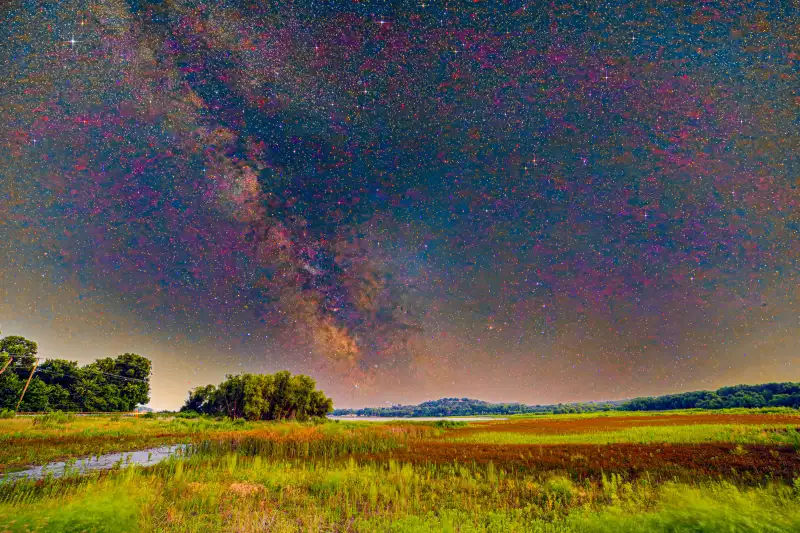
The core was only going to clear the tree line for a few hours before it dropped back out of reach, and this was already my third trip out chasing it this summer. The first two didn't come together — for one reason or another, the timing just never lined up. This one did. Fitting that it happened to fall on Father's Day.
The conditions
Capture Date: June 21, 2026
Location: Lake Weatherford — far enough from the DFW light dome to actually see the core with some structure in it
Bortle scale: 5 — not the darkest sky I've shot under, but far enough from the DFW light dome to actually see the core with some structure in it
Moon phase: Waxing Crescent, Illumination: ~51.3%
Weather: clear, low humidity, light breeze that kept the dew off the optics longer than usual
Nothing dramatic to report on the weather front — clear enough, calm enough, and after two trips that didn't pan out, "boring and clear" was exactly what I wanted.
(Quick aside, since I hear this mixed up constantly: what you're looking at is the galactic core — the dense center of the Milky Way — not "the Milky Way" as a whole. The whole galaxy arcs across the entire sky; this is just the brightest, busiest part of it.)
The gear + setup
For this one I went wide instead of zoomed — the Rokinon 14mm f/2.8 on the Canon EOS 6D, riding on the Move Shoot Move Nomad tracker. At 14mm you're not picking out individual nebulae or star clusters; you're framing the whole sweep of the core rising up out of the landscape, which meant the tracker mattered less for reach and more for letting me push exposure length without star trails creeping in at that focal length.
Five subs, 120 seconds each, ISO 1600. That's a longer stack than I'd usually run for a widefield like this, but with the core sitting lower on the horizon than I wanted, I needed every second of signal I could get before it dropped out of frame.
What happened
Nothing. And after the first two attempts fell apart before I even got a usable sequence, "nothing went wrong" felt like its own kind of win. Gear behaved, tracking held, five clean subs in the can.
Processing notes
This one went through more hands than usual, honestly, and each step was solving a specific problem:
N.I.N.A. for acquisition and framing — dialing in the composition before the shutter ever opened.
DeepSkyStacker to combine the five subs into a single stacked image.
VeraLux for the hyperbolic stretch, curves, and color balancing — this is where the core's dust lanes actually started showing up instead of just sitting as a bright smear. VeraLux features a dedicated suite of tools in Siril - specifically the VeraLux HyperMetric Stretch (HMS) and VeraLux Curves scripts—designed explicitly for advanced, color-safe stretching and tonal adjustments.
Photoshop for composite blending and finishing — this is where the iPhone foreground actually gets merged with the tracked sky exposure, matching light and perspective so it reads as one shot instead of two.
Lightroom for the final color grade and sharpening.
Every one of those steps earns its place — nothing in that chain is routine copy-paste processing. The GraXpert/Siril pass in particular is doing real work pulling faint structure out of a Bortle 5 sky that a darker site wouldn't need.
The result
What gets me looking at the final stack is how much of the core's structure actually held up — the dust lanes running through the center didn't just survive the Bortle 5 sky, they're some of the most defined I've pulled out of a widefield like this. Worth every one of those five subs.
Closing
Three trips to get here, and it happened to land on Father's Day. Two generations, one camera, one very patient tracker. The core's only going to climb higher as summer goes on, so there should be longer windows on the next clear night out. Let me know in the comments if there's a target you'd want to see next.
— Jesse
Leave a Comment
Reply to
2 Comments